- From statistical guarantees (Safe-RL) to theoretical, model-based guarantees via Acc-CBF-QP.
- Robust to out-of-distribution states: 92%–100% reduction in constraint violations on real hardware (Unitree H1 humanoid and Kinova Gen3 manipulator).
- No performance degradation in nominal conditions — and in some cases, improved performance (e.g. longer survival time under aggressive velocity commands on H1).
Abstract
Reinforcement Learning (RL) has demonstrated remarkable capabilities for solving complex robotic control problems, but its lack of safety guarantees severely limits deployment on hardware. In particular, as legged robots and manipulators often operate near safety-critical boundaries, out-of-distribution states can lead to failure upon deployment. To address this, we introduce Acc-CBF-QP, an acceleration-based Quadratic Program (QP) safety filter using Control Barrier Functions (CBFs) that constrains any RL policy onto a safe set at runtime without modifying training. The method applies to unconstrained and Safe-RL policies, and enforces joint position, velocity, torque, and collision constraints within a unified optimization framework. A key contribution is the formulation of RL+QP tasks that regulate deviation from the RL command when constraints would otherwise be violated. We introduce a TorqueTask, minimizing torque deviation, and a Forward Dynamics Task, minimizing induced acceleration deviation, thus providing principled control over safety-performance trade-offs. Experiments on a 7-DoF Kinova Gen3 manipulator and a 19-DoF Unitree H1 humanoid, both in simulation and on hardware, highlight substantial reductions in constraint violations. On the real H1 hardware, a Safe-RL policy alone yielded 10.04 violations/s, which were reduced by 92% to 0.80 violations/s when augmented with Acc-CBF-QP. On the Kinova Gen3, Acc-CBF-QP fully eliminated violations. Nominal task performance of the RL objective is preserved in violation-free regimes. Under aggressive velocity commands on H1, Acc-CBF-QP improves execution by preventing constraint-induced shutdowns, yielding longer survival times. The full pipeline is open-source.
Videos
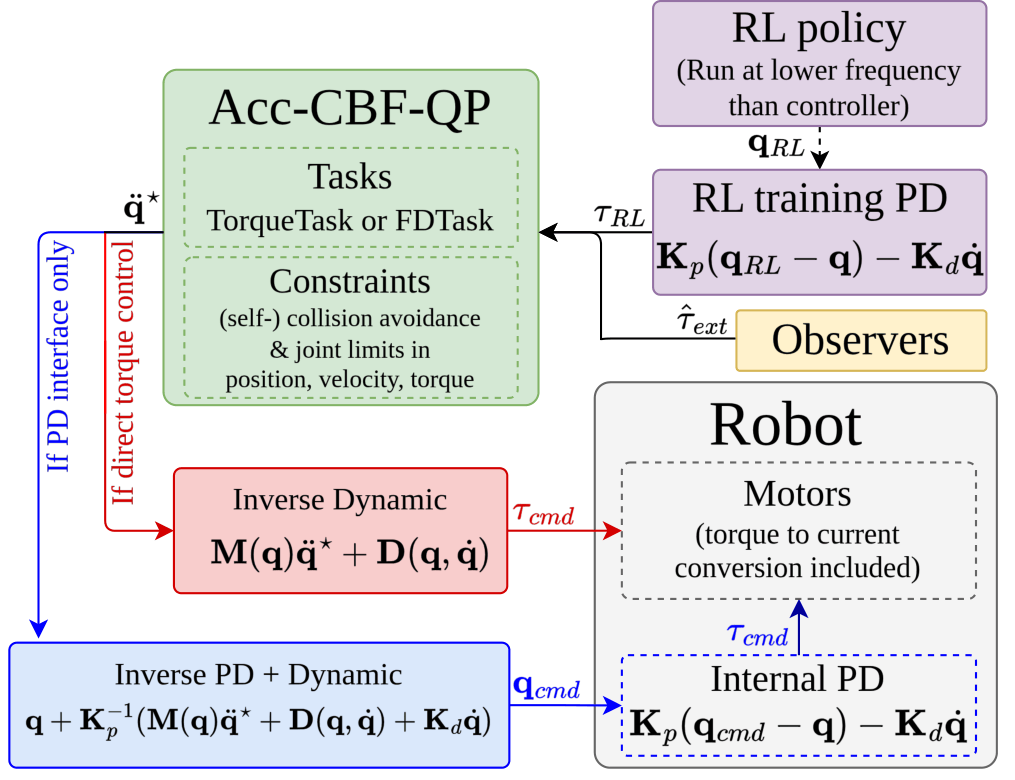
Controller pipeline. The RL policy (purple) is filtered in real time by an Acc-CBF-QP (green) that enforces safety constraints using external disturbance estimates from observers (yellow). The resulting feasible commands are applied in torque control (red) or with a position reference for a Proportional-Derivative (PD) controller (blue) to the robot (gray).
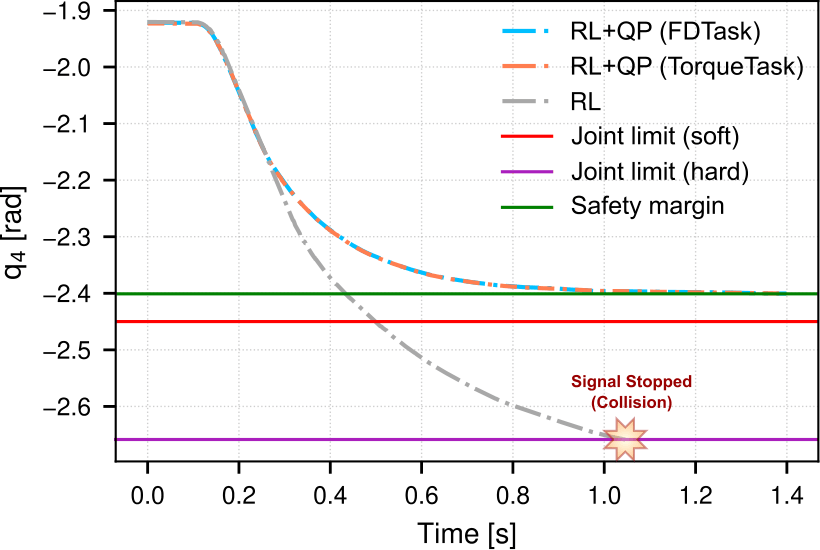
Kinova Gen3 joint limit violation comparison. Joint 4 position during OoD execution. RL alone (gray) exceeds the hardware joint limit, triggering a shutdown. Both RL+QP tasks (cyan and orange) strictly respect the joint limit constraints.
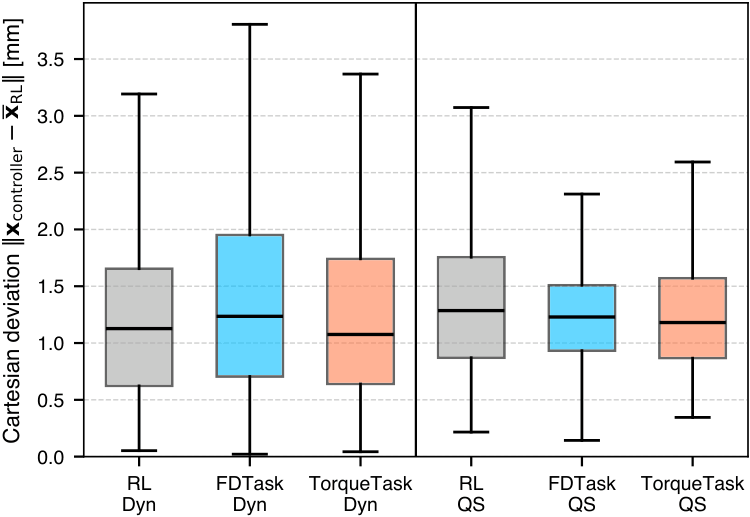
Kinova Gen3 behavior preservation under nominal conditions. Boxplots of Cartesian deviation relative to the mean RL trajectory, for RL (gray), FDTask (cyan), and TorqueTask (orange) during dynamic (Dyn) and quasi-static (QS) phases. Boxes show the median and interquartile range; whiskers extend to 1.5 times IQR.
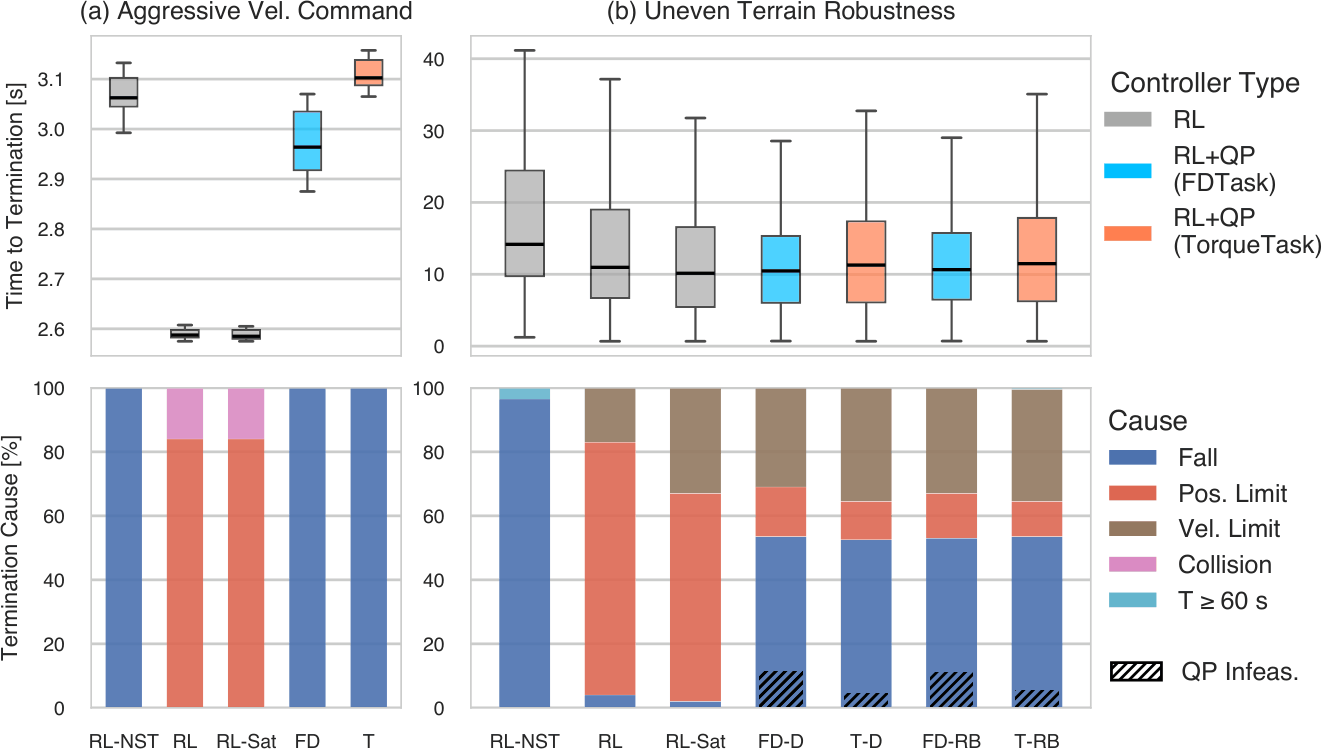
Unitree H1 performance impact of the Acc-CBF-QP across 200 paired simulation trials per controller. Top: survival duration (time to termination). Bottom: termination causes. Left: aggressive velocity command on flat terrain. Right: uneven terrain robustness. Boxplots show median and interquartile range (whiskers: 1.5xIQR). Stacked bars report termination categories (fall, joint/velocity limits, collision, timeout); hatched segments indicate QP infeasibility rates for damping (D) and rollback (RB) variants.
Paper Summary
Poster
-->BibTeX
@inproceedings{muraccioli:hal-05362571,
  TITLE = {{Safe Execution of RL Policies via Acceleration-based CBF-QP Constraint Enforcement for Real-World Robotic Deployments}},
  AUTHOR = {Muraccioli, Bastien and Cariou, Alice and Leziart, Pierre-Alexandre and Celerier, Mathieu and Demont, Arnaud and Venture, Gentiane and Benallegue, Mehdi},
  URL = {https://hal.science/hal-05362571},
  BOOKTITLE = {{IEEE/RSJ International Conference on Intelligent Robots and Systems (IROS 2026)}},
  ADDRESS = {Pittsburg, PA, United States},
  YEAR = {2026},
  MONTH = Sep,
  KEYWORDS = {Model Learning for Control ; Optimization and Optimal Control ; Robot Safety},
  PDF = {https://hal.science/hal-05362571v3/file/root.pdf},
  HAL_ID = {hal-05362571},
  HAL_VERSION = {v3},
}